
Date & Time: Wed, 18 Mar 2026 – Thu, 19 Mar 2026
Location: Tallinn University, Tallinn, Estonia
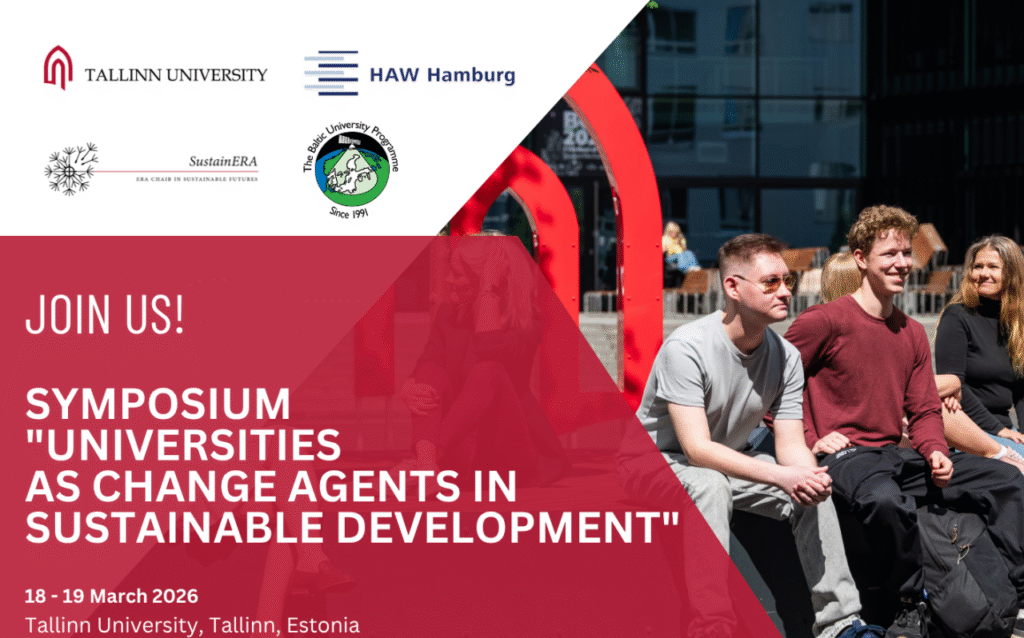
We are delighted to announce the international symposium “Universities as Change Agents in Sustainable Development”, taking place on 18–19 March 2026 at Tallinn University (Estonia). The Symposium is organised by the Research and Transfer Centre “Sustainable Development and Climate Change Management” at the Hamburg University of Applied Sciences in Germany, the Cluster on Adaptation and Mitigation of Environmental Change KEKO and the ERA Chair project on Sustainable Futures (SustainERA) at Tallinn University and the Baltic University Programme.
About the symposium
The global pursuit of the United Nations Sustainable Development Goals (SDGs) demands transformative action across all sectors of society. Universities, as hubs of knowledge creation, critical thinking, and future leadership, hold a unique and powerful position. They are not merely institutions of education but ecosystems capable of driving sustainability through research, teaching, operations, and community engagement.
The Symposium “Universities as Change Agents in Sustainable Development” is founded on the belief that the academic sector needs to move beyond siloed initiatives and theoretical discourse to become integrated, proactive, and measurable change agents. The event will provide a platform for forging new partnerships and co-creating actionable strategies that harness the full potential of universities to address the most pressing ecological, social, and economic challenges of our time.
Symposium Themes
Presentations, workshops, and posters will be organised around the following ten interlinked themes:
- a) Curriculum for a Sustainable Future: Pedagogical innovations, integrating SDGs across all disciplines, and fostering systems thinking and resilience in students.
- b) Sustainable University and Smart Campus: Implementing green infrastructure, achieving carbon neutrality, circular economy models on campus, and leveraging smart technology for sustainability.
- c) Research for Impact: Designing transdisciplinary research projects that directly address local, regional and global sustainability challenges and lead to tangible societal benefits.
- d) University-Community Partnerships: Models for co-creation with local communities, social innovation hubs and businesses, and contributing to just urban and regional transitions.
- e) Digital Innovation for Sustainability: Exploring the role of AI, big data, and digital twins in modelling sustainable solutions and optimising resource use.
- f) Policy Engagement and Advocacy: How universities can effectively inform and influence environmental and social policy at local, national, and international levels.
- g) Green Skills and Future Labour Markets: Aligning educational outcomes with the growing demand for sustainability expertise in the global economy.
h) Social Justice and Inclusive Sustainability: Ensuring the transition to a sustainable future is equitable and addresses issues of diversity, inclusion, and indigenous knowledge. - i) Student-Led Initiatives & Changemaking: Harnessing student passion and leadership through incubators, green offices, and activist movements within universities.
Publication opportunity
Papers accepted for the event and presented during it may be submitted as chapters to the book Universities as Change Agents in Sustainable Development, to be published by Springer Nature within the World Sustainability Series, a leading peer reviewed series on sustainability in higher education: https://www.springer.com/series/13384
Call for abstracts
We warmly invite researchers, university leaders, educators and practitioners to submit any complete, original, and unpublished research papers, either conceptual or empirical. To participate, participants need to submit an abstract of 200 to 300 words, along with the authors’ names and full contact details, before 15th December 2025. Abstracts should be submitted by using the following form: https://forms.office.com/e/R6r96YnNQY
Deadlines
Deadline for submission of abstracts: 15th December 2025
Deadline for registrations: 1st February 2026
Deadline for full papers: 30th April 2026
Official information & registration
Full details, including the official call, participation options and updates, are available via HAW Hamburg’s announcement page: